Subterranean termites require continuous contact with ground soil moisture to survive, building mud tubes over masonry footings to breach structural framing. In historic wood-frame bungalows across Seminole Heights,…
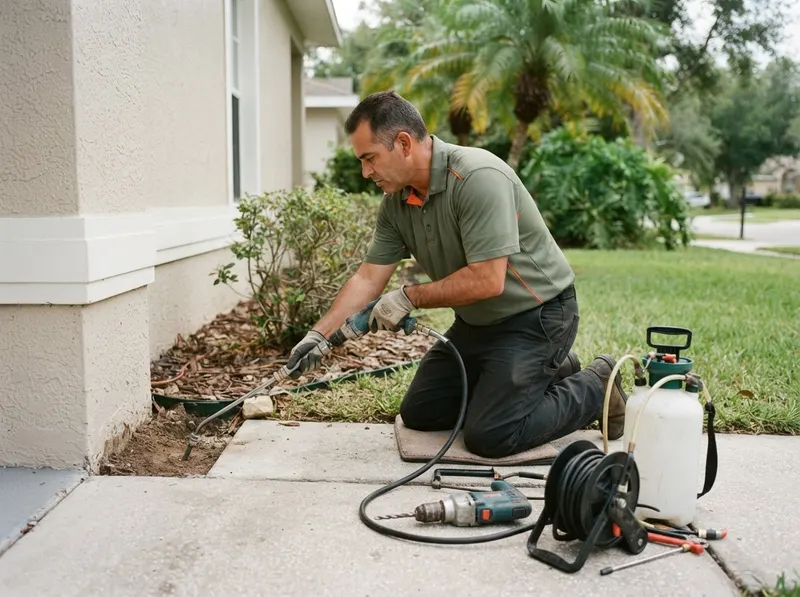
Subterranean termites require continuous contact with ground soil moisture to survive, building mud tubes over masonry footings to breach structural framing. In historic wood-frame bungalows across Seminole Heights, Tampa Heights, and Ybor City, off-grade foundations create humid crawlspaces where floor joists sit within 18 inches of damp dirt, demanding trenching and direct pier-pillar treatments. Modern monolithic concrete slabs common throughout Westchase, Palma Ceia, and New Tampa face different structural vulnerabilities, as termites enter through plumbing penetrations and expansion cold joints hidden beneath tile or engineered flooring. Subterranean termite treatment prevents structural collapse by creating an uninterrupted chemical barrier around the structural footprint or by deploying hexaflumuron or noviflumuron baiting stations spaced every 10 to 15 linear feet along the drip line.
Selecting the correct defensive method depends entirely on soil saturation and foundation design. A continuous liquid soil termiticide barrier, utilizing non-repellent agents like fipronil, binds to the soil particles and allows foraging insects to unknowingly track the lethal active ingredient back into the subterranean nest. Liquid perimeter treatments deliver immediate colony suppression within 60 to 90 days. However, low-elevation waterfront parcels along Bayshore Boulevard, Davis Islands, and Ballast Point often experience water tables within 2 feet of the surface during rainy summer months, where liquid soil applications risk displacement. In these saturated perimeter zones, low-impact monitoring stations provide an alternative, utilizing active cellular matrices that suppress the subterranean colony without saturating the soil with high-volume liquid chemicals. The trade-off centers on time versus ground disturbance: liquid applications provide day-one perimeter protection but require trenching and concrete drilling, whereas monitoring systems avoid structural drilling but require systematic quarterly monitoring to confirm colony elimination.
Homeowners frequently confuse subterranean termites with drywood termites, which leads to incorrect interventions. Drywood termites live entirely inside dry structural framing or roof trusses and require whole-structure tent fumigation with sulfuryl fluoride or localized wood injections. Subterranean termites nest underground and will survive roof fumigations untouched because the core colony lives beneath the foundation. Step one begins with a comprehensive physical assessment to locate soil tube entries, moisture meters along baseboards, and mud tubes behind drywall. Step two establishes the defense perimeter: technicians excavate a 6-inch-wide by 6-inch-deep trench into the soil adjacent to all exterior walls or drill 1/2-inch holes through adjoining concrete patios every 12 inches to saturate the underlying earth. Step three applies non-repellent termiticide at the standard label rate of 4 gallons per 10 linear feet per foot of depth, followed by backfilling and sealing all drill holes with masonry plugs. Step four establishes annual perimeter inspections to detect environmental disturbances caused by landscaping, pipe leaks, or soil erosion.
Every job gets a firm, written price after a free on-site visit.
Tell us about your subterranean termite treatment job in Tampa and we'll send a clear, written quote, usually the same day.
 Palmetto Hawk Pest Control