Drywood termite spot treatment serves as an operative perimeter defense when colonies remain isolated within accessible framing timbers. In historic neighborhoods like Seminole Heights, Tampa Heights, and Ybor City,…
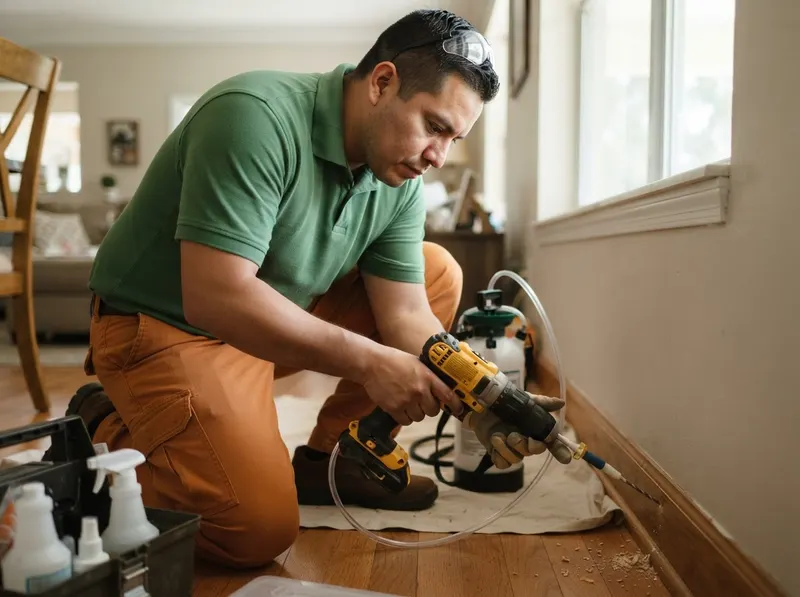
Drywood termite spot treatment serves as an operative perimeter defense when colonies remain isolated within accessible framing timbers. In historic neighborhoods like Seminole Heights, Tampa Heights, and Ybor City, homes frequently incorporate dense heart-pine framing and original tongue-and-groove flooring where drywood termites (Cryptotermes brevis) excavate galleries along grain lines. These pests require zero soil contact, deriving metabolic moisture entirely from structural lumber. A spot treatment applies localized termiticides, such as non-repellent transfer agents or borate foam formulations, directly into the gallery network through 1/8-inch precision access holes. When drywood infestations are caught early, this surgical application halts gallery expansion without subjecting household pets or residents to multi-day structural fumigation evacuations.
Decision guidance dictates that localized treatment fits contained infestations visible through kick-out pellets, drywood frass piles, or isolated swarmers emerging from single window jambs or attic trusses. If an attic truss in Palma Ceia or a door casing on Davis Islands reveals localized gallery chambers under 6 to 8 linear feet, precision drill-and-injection neutralizes the colony effectively. The operational trade-off centers on spatial scope: spot treatments neutralize active insects within reachable, targeted lumber, but they do not penetrate concealed framing trapped behind solid masonry, plaster, or unexposed ceiling planes. If termite frass emerges across three non-adjacent rooms simultaneously, structural fumigation represents the necessary protocol, whereas isolated strike points favor precise localized injection.
Subtropical humidity along coastal corridors like Ballast Point, the Channel District, and Westchase accelerates timber decay, creating prime entry thresholds for drywood swarmers following warm spring rains. Standard retail chemical sprays evaporate on surface lumber and fail to penetrate deep interior galleries. Professional localized defense operates through a systematic sequence: technicians test lumber density, bore injection ports directly into the hollowed gallery voids, inject calibrated termiticide under controlled pressure, and seal external openings with specialized dowels. This focused approach eliminates isolated drywood colonies while bypassing generic chemical barriers and high-pressure multi-year contracts.
Every job gets a firm, written price after a free on-site visit.
Tell us about your drywood termite spot treatment job in Tampa and we'll send a clear, written quote, usually the same day.
 Palmetto Hawk Pest Control